

Podcast: Play in new window | Download
Subscribe to The Innovative Therapist Podcast! Apple Podcasts | Spotify | RSS | More
The Innovative Therapist Podcast | Episode 41 (From the Archives)
“I’m just not motivated.”
“I just need more willpower.”
“Why can’t I seem to stick with anything?”
Have you ever said or thought something like this?
If so, I want to introduce you to a different way of thinking about motivation.
Because one of the most important things I’ve learned from studying motivation and behavior change for more than 20 years is this:
It’s not just how much motivation you have. It’s the TYPE of motivation driving your behavior.
And that distinction can change everything.
In Episode 41 of the podcast (originally published as Motivation Made Easy), I explore the science of motivation and how we can shift away from guilt, shame, pressure, and “shoulds” toward something much more sustainable.
Free Resource: Make Movement Feel Good Again
If exercise has become another thing you feel like you should do, I created a free Guided Walk to help you approach movement differently.
Through a combination of music and guided reflection, you’ll reconnect with gratitude for what your body can do, how you want to feel, and the deeper reasons you want to care for yourself.
It’s a simple way to begin shifting from pressure and obligation toward more autonomous, self-supportive motivation.
What If the Problem Isn’t Your Willpower?
So many people I work with have spent years trying to become more disciplined.
They’ve tried stricter food rules, more structured exercise routines, accountability programs, and countless strategies to force themselves to follow through.
And sometimes these strategies work.
For a while.
But when the motivation is primarily coming from pressure, guilt, fear, or the belief that we’re somehow not good enough as we are, maintaining those changes can become exhausting.
This is especially relevant when it comes to binge eating, emotional eating, exercise, and weight management.
The good news is that motivation isn’t simply something you either have or don’t have.
We can learn to cultivate a different quality of motivation.
The Science of Sustainable Motivation
Self-Determination Theory (SDT) is one of my favorite frameworks for understanding human motivation.
Developed by psychologists Edward Deci and Richard Ryan, this theory helps explain why some behaviors feel energizing and sustainable while others leave us feeling pressured, resentful, or depleted.
In Episode 39, I discussed three basic psychological needs that support healthy motivation and well-being:
- Autonomy: Feeling that we have choice and ownership over our actions.
- Competence: Feeling capable and effective in what we’re doing.
- Relatedness: Feeling connected to and supported by others.
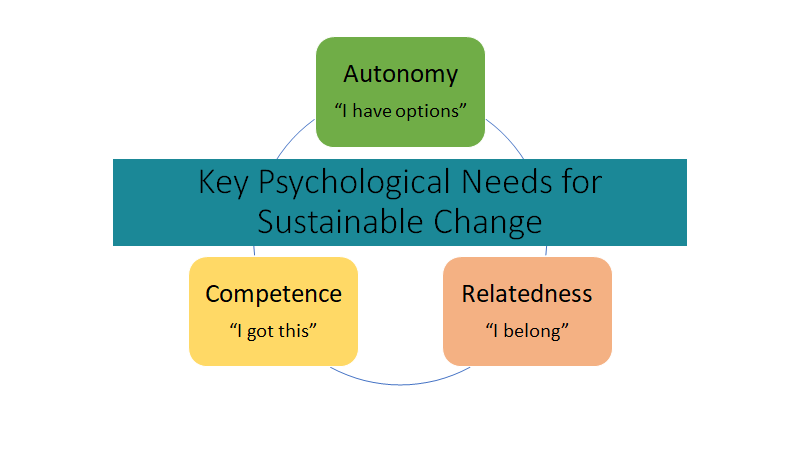
When these needs are supported, we’re more likely to develop autonomous motivation, meaning our actions feel personally meaningful and self-endorsed.
When they’re consistently undermined, motivation can become more controlled, driven by external expectations or internal pressure.
And here’s where things get interesting.
The Different Types of Motivation
Not all motivation is created equal.
Self-Determination Theory describes several types of motivation along a continuum, ranging from more controlled to more autonomous.

1. External Motivation
This is when we do something primarily to obtain a reward or avoid a consequence.
For example:
- Exercising because someone told us we need to lose weight.
- Following a food plan to get approval from a healthcare provider.
- Completing a task primarily because we’ll be rewarded or punished based on the outcome.
External motivators aren’t inherently bad. But when they’re our primary reason for doing something, they may not provide the foundation we need for lasting change.
2. Introjected Motivation
This one is particularly interesting because the pressure is coming from inside us.
We might think:
“I should exercise today or I’ll feel guilty.”
“I need to stop eating this way. What’s wrong with me?”
“If I don’t accomplish enough today, I’m being lazy.”
The behavior is being driven by guilt, shame, anxiety, or the need to prove our worth.
It can feel like self-discipline, but it’s often another form of pressure.
And for people who struggle with perfectionism, people-pleasing, or a harsh inner critic, this type of motivation can become incredibly familiar.
3. Identified and Integrated Motivation
Now we’re moving toward more autonomous forms of motivation.
Identified motivation means we recognize that a behavior is personally important, even if we don’t always enjoy doing it.
For example:
“I want to move my body regularly because maintaining my strength and mobility matters to me.”
Integrated motivation goes a step further. The behavior fits with our broader values, priorities, and sense of who we are.
“I’m someone who values caring for my body and making time for the things that help me feel well.”
Notice the difference?
We’re no longer trying to force ourselves to become someone acceptable.
We’re making choices that reflect what genuinely matters to us and our identity has shifted.
4. Intrinsic Motivation
Intrinsic motivation is when we engage in an activity because the activity itself is enjoyable, interesting, or satisfying.
Maybe you love dancing, hiking, swimming, gardening, or playing basketball.
You do these things because you genuinely enjoy them.
But here’s an important distinction:
You don’t have to love every behavior for it to be autonomously motivated.
Sometimes the most meaningful things we do aren’t particularly fun in the moment.
We can still choose them freely because they support the life we want to create.
From Self-Control to Self-Trust
This is where my thinking and clinical work have continued to evolve over the years.
I used to focus much more specifically on helping people develop sustainable motivation for eating and exercise.
And while I still do that work, I’ve come to see that the deeper transformation is often about something much bigger.
Learning to trust ourselves.
Trusting that we can make choices without constantly monitoring, criticizing, or controlling ourselves.
Trusting that our needs, preferences, and desires matter.
Trusting that we can pursue meaningful change without making our worth dependent on the outcome.
For many people, this involves more than learning motivation strategies.
It may also involve exploring the protective patterns, past experiences, and beliefs that make it difficult to feel safe choosing what we actually want.
And that’s where the intersection of motivation science, self-compassion, and parts-informed work becomes so powerful.
5 Ways to Develop More Autonomous Motivation
Although I originally discussed these strategies in the context of exercise, they can apply to many areas of life.
1. Get Curious About What You Actually Enjoy
Rather than asking, “What should I be doing?” try asking:
What feels good to me?
What am I naturally drawn toward?
What would make this experience more enjoyable or meaningful?
If movement has always felt like punishment, perhaps it’s time to experiment with a completely different kind of movement.
And if you’re trying to build a new habit, consider how you might make the process more enjoyable rather than relying exclusively on discipline.
2. Create a Plan That Actually Works for You
Just because someone says the best time to exercise is 5:30 a.m. doesn’t mean that’s the best time for you.
Your preferences, energy, circumstances, and responsibilities matter.
Autonomy-supportive behavior change involves experimenting, adjusting, and developing routines that fit your actual life.
Flexibility isn’t necessarily a lack of discipline.
Sometimes it’s exactly what makes consistency possible.
3. Surround Yourself With Supportive People
Our relationships influence our motivation.
Think about the difference between someone who says:
“You really need to get serious and stop making excuses.”
And someone who asks:
“What would feel supportive right now? How can I help?”
The second approach is much more likely to support autonomy, competence, and relatedness.
Look for relationships and communities where growth is encouraged without shame or judgment.
4. Notice When Shame or Pressure Is Driving Your Behavior
This is one of my favorite practices.
The next time you find yourself thinking, “I have to” or “I should,” pause and get curious.
Whose expectation is this?
What am I afraid will happen if I don’t do it?
Is this something I genuinely value, or am I trying to prove something about myself?
You don’t need to judge the answer.
Simply noticing the difference between controlled and autonomous motivation is a meaningful first step.
5. Connect Your Actions to the Life You Actually Want
Rather than focusing exclusively on the behavior you’re trying to change, zoom out.
What kind of life do you want to create?
How do you want to feel in your body?
What relationships, experiences, and activities matter most?
What kind of person do you want to be?
When we connect our everyday choices to our deeper values, we create opportunities for more meaningful and sustainable change.
And sometimes, as we get clearer about what really matters, we discover that some of the goals we’ve been pursuing aren’t actually ours to begin with.
It’s Never Too Late to Change Your Relationship With Motivation
Years ago, when I was struggling with my own diet-binge cycle, I wrote something in my journal:
“I’m terrified I’m wasting my life.”
Looking back, I can see how much time and energy I was spending trying to control my body and eating.
And how much of my life was being organized around those efforts.
One of the most meaningful shifts was beginning to ask different questions.
Not just:
How do I get myself to follow the rules?
But:
What do I actually want?
What matters to me?
What would it look like to build a life that feels nourishing, meaningful, and truly my own?
Those are questions I continue to explore in my own life and in my work with clients.
And if you’re someone who has spent years trying to motivate yourself through pressure, guilt, or self-criticism, I hope this episode offers a different possibility.
You don’t necessarily need to become better at controlling yourself.
You may need to become better at understanding, supporting, and trusting yourself.
Listen to Episode 41
In this episode, we explore the different types of motivation and how to begin moving toward motivation that supports sustainable behavior change.
Want Support Making Lasting Changes?
I’m Dr. Shawn Hondorp, a board-certified clinical health psychologist, coach, and host of The Innovative Therapist Podcast.
I help thoughtful adults who are tired of the binge eating, emotional eating, perfectionism, and self-criticism cycles develop greater self-trust and create meaningful, sustainable changes.
My approach integrates evidence-based psychology, motivation science, self-compassion, and parts-informed work.
I currently offer 1:1 therapy and coaching, with virtual options available.
Learn More About Working With Me
A Free Resource to Explore
If movement has become another thing on your list of “shoulds,” I also created a free Guided Walk designed to help you reconnect with appreciation for your body and how you want to feel.
It’s a different way to approach movement, with less pressure and more connection.
Disclaimer: This blog and podcast are for educational and informational purposes only and are not a substitute for individualized medical or mental health care. Reading or listening does not establish a provider-patient relationship.