
Podcast: Play in new window | Download
Subscribe to The Innovative Therapist Podcast! Apple Podcasts | Spotify | RSS | More
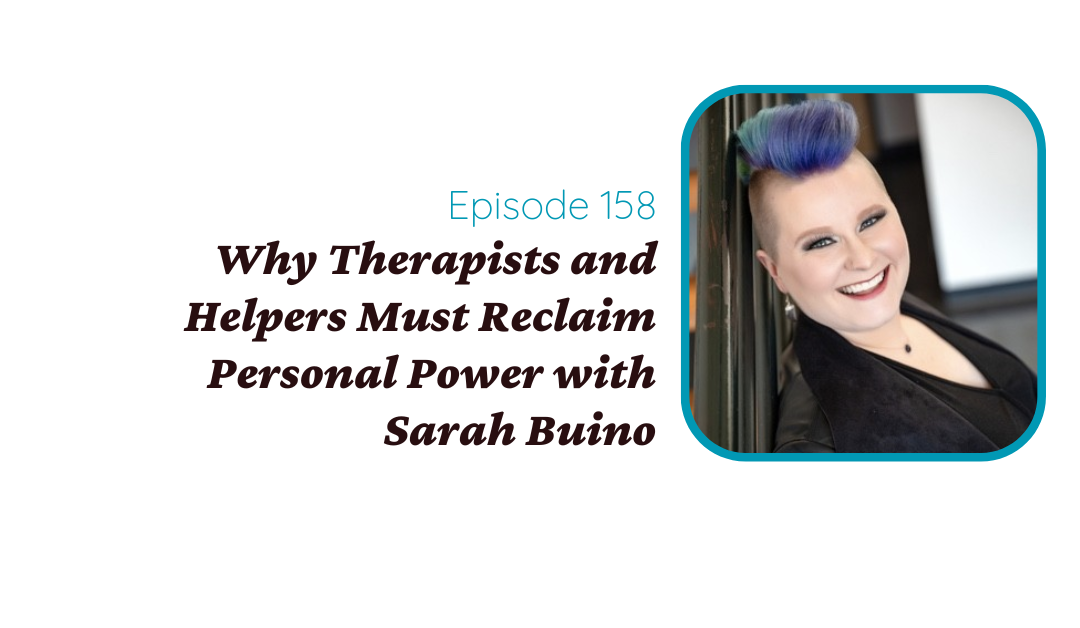
Episode 158: Why Therapists and Helpers Must Reclaim Personal Power with Sarah Buino
✨ Free resource: Uncover Your Zone of Genius
https://pages.drshawnhondorp.com/zone
You can have all the clinical skills in the world, but if you feel disconnected from your own personal power, your work (and your life) will start to shrink.
Hey friends. Welcome back to the Innovative Therapist Podcast. I’m so excited about today’s episode because Sarah Buino is back with me for round two. We recorded yesterday for her podcast, and now we get to keep the conversation going here.
Also, we have to start where all meaningful professional relationships begin: unhinged laughter at a conference.
We met at the Next Level Summit back in September, and I happened to be sitting right next to Sarah during the “humor as healing” portion. It was late. We were tired. We’d come back from dinner. There may have been drinks. And then we did this exercise where you’re instructed to laugh as hard as you possibly can.
Sarah absolutely stole the show. Her laugh was so contagious that my mild headache disappeared afterward. Like… fully gone. So yes, this episode may include an unofficial headache cure, but also it includes something I think is even more important:
A conversation about personal power, why therapists often lose touch with it, and why reclaiming it is essential if we want to evolve this field without burning ourselves (and each other) to the ground.
What we get into in this conversation
This episode is for therapists and helpers who feel any of the following:
- a little numb or constricted lately
- tired of the drama and harm happening in our professional spaces
- ready to do “inner work” in a way that actually changes something
- curious about how power, shame, and agency show up in therapy rooms and workplaces
Here are some of the big themes we explored:
- Sarah’s shift from heavy clinical work to coaching, consulting, speaking, and leadership
- Why therapists often misunderstand power and accidentally recreate “power over” dynamics
- The Right Use of Power framework and why it matters so much right now
- Agency and shame through the lens of NARM (NeuroAffective Relational Model)
- Why your own healing is not optional if you want to do ethical, embodied work
- How to build workplaces (and communities) that feel more like power with, not “who’s winning?”
Sarah’s work right now (and why it matters)
One of the most interesting parts of this conversation was hearing how Sarah’s work has evolved.
She shared that she only has three clinical clients left, and they’re all healers/helpers. Her primary modality is NARM, which she described as the approach that truly helped her “crack the code” of her own healing.
She’s also:
- Podcasting (a lot)
- Doing consulting/speaking
- Serving as Board President of the Right Use of Power Institute
- Building a platform to help therapists and group practice systems evolve through power-conscious leadership
And what I loved most is that she’s not just talking about power as an intellectual concept. She’s talking about it as a lived, nervous-system-level experience.
What does “Right Use of Power” actually mean?
Sarah broke down a framework that I think every therapist should understand, because it gives language for dynamics we often feel but don’t know how to name.
She describes six types of power (and if you’ve ever been confused by power in therapy, leadership, or relationships, this framework is clarifying):
1) Personal Power
The power that belongs to you. Everyone has it. We can’t lose it, but we can feel disconnected from it.
2) Role Power
Power that comes from your role: therapist, boss, doctor, parent, supervisor.
3) Status Power
Power tied to social location: race, gender, age, ability, class, body size, etc. (and how those are valued by culture).
4) Collective Power
Power that comes from people organizing together for a shared mission (can be used for harm or good).
5) Systemic Power
When power becomes embedded in laws, policies, institutions, and societal norms.
6) Universal Power
A sense that something larger holds us: nature, God, spirit, the universe, meaning, life force, whatever resonates.
One of my biggest takeaways was how she framed universal power as a necessary anchor in chaotic times:
When systems feel enormous and crushing, remembering there’s something larger can restore hope, orientation, and possibility.
Why therapists get stuck (and why shame is often the mechanism)
We talked about why so many therapists aren’t doing their own work, and Sarah named something that felt really important:
Often, it’s fear.
Fear of what they’ll find.
Fear of what others will think.
Fear of losing the pedestal.
And then there was this thread that I think matters deeply for helpers:
If your identity is fused with being “the strong one,” “the healer,” “the one who has it together,” you might unconsciously use helping as a way to avoid your own pain.
Sarah named pathological empathy, and how even therapists who have done a lot of boundary work can still have a deeper layer of:
- trying to fix
- taking on others’ pain
- over-identifying with responsibility
- staying in outcome-driven helping
This is where personal power becomes everything.
Not power over others.
But power in yourself.
The ability to stay present without rescuing.
A big invitation from this episode
Sarah said something I want to echo here:
Your own work is the most powerful healing tool you have.
Not your training.
Not your next certification.
Not the perfect intervention.
Your ability to be a clear, grounded, honest channel… is the gift.
And that’s not about being perfect.
It’s about being willing.
It’s about being real.
A gift for you
If this episode sparks something in you and you’re like, “Okay… but how do I reconnect with myself and what lights me up?” start here:
✨ Uncover Your Zone of Genius
https://pages.drshawnhondorp.com/zone
It’s a free reflection guide that helps you reconnect with:
- what energizes you
- your strengths and gifts
- the work and creativity that actually makes you feel alive
When you download it, you’ll also join my email list, where I share:
- reflections like this
- upcoming workshops + gatherings
- resources on creativity, autonomy, leadership, and healing
- community invitations
Where to find Sarah (and what she shared)
Sarah’s main hub: Head Heart Biz Therapy
Website: (as shared in the episode) headheartbiztherapy.com
If you’re in group practice as an owner or employee: Group Practice Revolution
Website: (as shared in the episode) grouppracticerevolution.com
And her podcast: Conversations with a Wounded Healer
(If you search that, you’ll find the embedded Group Practice Revolution episodes too.)
🎁 Also: Sarah mentioned she’s going to create a training code/discount for listeners.
For listeners of the podcast: INNOVATE will give 20% off of any Basics training.
To redeem the coupon codes:
Visit: https://rightuseofpower.org/events/ and select the Basics training you’d like to attend. Choose the REDUCED RATE ticket and enter the code at checkout.
I already attended this and it was excellent.
Your listeners can also get a copy of Dr. Amanda’s new book Shaping Power For Good at this link: https://rightuseofpower.org/product/shaping-power-for-good-wayfinding-to-right-relationship-pre-sale/
Before you go
If you’ve felt yourself shrinking lately, second-guessing yourself, or getting pulled into professional dynamics that feel reactive, rigid, or dehumanizing…
This is your reminder:
You don’t need more self-improvement.
You need reconnection.
You need agency.
You need your power back.
And it doesn’t have to look flashy.
It can start with one honest moment of noticing what’s happening inside you, and choosing differently.
Disclaimer:
This blog and podcast content are for educational and informational purposes only and do not constitute medical or mental health advice.